
Caleb University dons dissect Nigeria\'s economy before 2027 elections
The duo of Dr. Raymond Alenoghena and Dr. Felicia Adeyemo have shed light on how Nigeria could navigate its economic landscape in 2026.
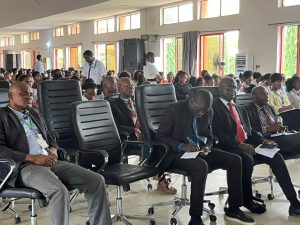
The duo, who are lecturers at the Caleb University’s College of Art, Social and Management Sciences (CASMAS), spoke at a symposium put together by the institution’s Centre for Political Issues and Economic Thoughts on Thursday, May 7, 2026.
The symposium with the theme- “Nigeria’s Economic Outlook in Pre-Election Year: Navigating Domestic Trends and Global Geopolitics Shocks,” focused on strategies for growth, challenges and sector-specific development in 2026, the year preceding the country’s general election.
[video width="1024" height="576" mp4="/media/uploads/2026/05/VID-20260521-WA0005.mp4"][/video]With the Bretton Wood institutions – World Bank and the International Monetary Fund (IMF) 4.4 percent Gross Domestic Product (GDP) growth projection for Nigeria in 2026, the dons explained that reforms initiated by the current administration in critical sectors require businesses and investors to adopt a pragmatic approach to navigate high operating costs and stay afloat.
In his earlier remark, the Director of the Centre, Dr. Samuel Idowu, reminded the audience of the typical pre-election year’s scenario in Nigeria’s political space.
“In Nigeria’s political system, the pre-election year, often referred to as the penultimate year, witnesses a lot of activities – party primaries and campaigns among others," he stated.
Highlights of the presentations:
- Economic stability:
As the year progresses, political activities - primary election, litigation and high-level expenditure arising from campaigns will increase liquidity or more money in circulation, thus reversing the minimal gains recorded in 2025. To navigate the domestic trends in 2026, the following were recommended.
- Diversification of the economy and improving the contributions of non-oil sectors.
- Shift from resource-led growth by scaling up industrial production, high-value processing and manufacturing.
- Lay foundation for Micro, Small and Medium Enterprises (MSMEs) and local entrepreneurs to drive the economy.
- Actively monitor and report quarterly financial data to bolster investor confidence.
- Reduce cost of governance
- Continue CBN’s reforms to stabilize the FX market and reduce inflationary pressures
 2. Prioritise security
The country is currently heavily plagued by insecurity with terrorism and kidnapping prevalent in the North and other parts of the country.
Recommendations- Implement an effective security approach to mitigate supply chain disruptions.
3. Geopolitical shocks
The United States, Israel and Iran hostility in the Middle East is disrupting the internal political-economy. This is a global political crisis destabilizing internal stability, underscoring the country's vulnerability and susceptibility to external vagaries.
With Nigeria relying on fuel imports, the conflict in the Middle East or trade protectionism can quickly shoot up transportation and food costs.
Recommendations:- Recalibrate the growth model to shift from oil dependence toward a diversified, inclusive economy that addresses rising poverty, high unemployment, and severe infrastructure deficits.
- Increase crude oil sales during these Middle East tensions will allow the country to capitalize on higher global prices and fill supply gaps created by regional disruptions.
With the 2027 general elections on the horizon, the pre-election year of 2026 brings specific political-economic dynamics that intersect with structural reforms and external shocks.
It presents a mix of high-yield opportunities and structural risks, including potential inflation from increased liquidity, currency volatility, and policy uncertainty.
 Recommendations:
- Businesses and investors must focus on sectors with dollar-denominated revenue, enhancing liquidity, and leveraging reforms implemented since 2023, such as the exchange rate unification and subsidy removal.
- Design products people can afford to ensure wider market penetration, increased sales, and stronger brand loyalty.
- Cut wastes on operations by reducing unnecessary material use, energy consumption, and inefficient processes. This will ensure significant financial, environmental, and organizational benefits.
- Sign 6- 12 month supply contracts to lock in costs rather than absorbing monthly price shocks.
Related stories
Caleb University holds workshop on sustainability and environment
Caleb University, Imota, Lagos, will on Tuesday, May 26, 2026, hold a workshop to address issues affecting the environment. The seminar, theme: “Sustainability and the Environment: LEGACY FOR THE UPCOMING GENERATION,” will take place at the University Multipurpose Hall and featured presentations by industry experts. According to a statement issued by the University’s Information, Media and Publication Specialist, Olawale Adekoya, the duo of Engr. Jamiu Badmus and Mr. Olusola
Caleb University shines at ACA/PILIWA moot court competition
Caleb University, Lagos, has once again affirmed its stature as a force in legal education following an outstanding performance by its College of Law at the recently concluded ACA/PILIWA Moot Court Competition for students in the country’s higher institutions. The highly competitive contest organised by the Advocate for Community Alternatives (ACA) in partnership with the Public Interest Lawyering Initiative for West Africa (PILIWA), was hosted at Caleb University’s Magodo Ci
Photos: Caleb University hosts education collaborative to strengthen institutional engagement
Caleb University, Lagos, has hosted a landmark “Education Collaborative” Open House Day designed to deepen institutional partnerships, research collaboration and academic innovation in the higher education sector. In his remark at the event, themed: “Strengthening Institutional Engagement,” the Vice-Chancellor of the University, Prof. Olalekan Asikhia, commended the Centre for Grants and Endowments for organising a programme that aligns with the institution’s vision for excel